
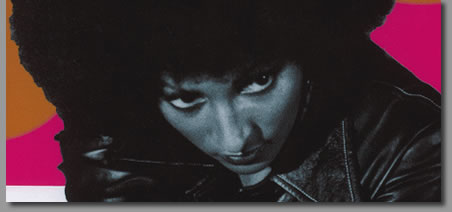
Broken promises in the dark: The evolving image of black women in American film
A Discussion with Vassar professor Mia Mask by Jay Blotcher

The Hollywood film industry has rarely been an engine of social advancement. Its silver-screen images were meant to merely reflect the status quo—with a little wish-fulfillment added. Social justice in mainstream movies is rare; for decades, maligned groups such as Jews, gays and people of color suffered either invisibility or bruising stereotypes.
Even today, black depictions in mainstream films tend to be self-conscious exercises; they are either a result of—or a defiant stand against—our dubious cinematic history of African-Americans. Consider this: how many blacks onscreen today are simply portraying people, rather than black people? American filmic depiction of blacks has evolved, but not expansively since 1915’s racist epic, Birth of a Nation. Moviehouse blacks have made the transition from shambling buffoons and amoral sirens to saintly everyman, from Blaxploitation cartoons to superstars Denzel and Halle. But the normalization of the African-American actor has yet to be achieved. The studios are far from being color-blind.
The persistent problems of representing African-American people onscreen—specifically women—receives a thorough deconstruction in the new book Divas on Screen: Black Women in American Film (University of Illinois Press).
Author Mia Mask, Associate Professor and Chair of the Department of Film at Vassar College, is that uncommon academic: she travels between the rarefied demimonde of the intellectual and the clubhouses of popular culture. To capture the fitful progress of black women in film, she analyzes the commercial output of five avatars: Dorothy Dandridge, Pam Grier, Whoopi Goldberg, Oprah Winfrey and Halle Berry. Some were constrained by their era, while others struggled to surpass the twin limitations of studio and social setting.
Make no mistake; this is no breathless tell-all; Mask does some heavy intellectual lifting in her quest to assess how society formed these women—and, in turn, how black female film stars affected American race relations. She draws her findings from studies by high-minded scholars as well as from fan magazines.
In a late September interview in her Vassar office, Professor Mask explained to Roll cultural writer Jay Blotcher what the careers and films of these five women tell us about American life.
How can commercial films created solely for box-office profits possess the gravitas to be considered social history?
All of these representations of black women in popular culture are important because they’re part of a larger canon or series of representations. I place them in the broader context in my [Vassar] courses on African-American cinema. But I can’t really talk about African-American cinema without looking at the various directors and filmmakers, and the people who starred in the films. So I talk about Paul Robeson: incredible figure, incredible man, so many accomplishments. But when you look at some of the films that he made, they often fell short of who he was. Talking about that gap, as many people have done in their research and in documentary films, is important; that gap is part of the African-American experience. Even though some of the films are commercial—in Pam Grier’s case they are exploitation films—they are also part of the black American experience.
Is it possible to identify a causal relationship between a successful mainstream film about a black woman and demonstrations of empowerment in black culture?
Often, that is in the response you get from viewers. That is, the fan culture. Quite a bit of film studies does look at fanzines and fan magazines. What kind of distribution and readership did they have? That’s one indication of the extent to which people are looking to, looking for, and are interested in, the narrative or diagetic or extra-narrative or extra-diagetic life of the star. So they’re interested in the star persona, but also in the person beyond their life in film.
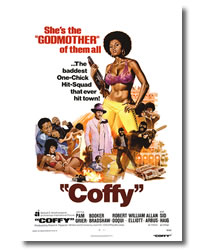
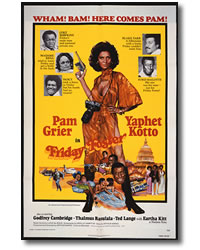
With Pam Grier (Coffy, Foxy Brown), it’s very easy to recognize that appeal, that sense of empowerment. Every time I told people about the book I was writing, people always wanted to talk to me about Pam Grier. It’s the fact that people know these women. You have to remember that with African-American stars and performances, they don’t get the same mainstream exposure that white stars get. So a lot of people don’t remember who certain figures are. But the fact that people know these women—on a national and international level—speaks to a recognition and identification on the part of the spectator.
Among the women you analyze in this book, who was most cognizant of her powers, her resources, and was able to manipulate her public and onscreen image best?
Oprah Winfrey, for all the obvious reasons. Oprah is a phenomenon and understands the media marketplace maybe better than anybody. She is also incredibly talented at presenting herself as the Everywoman, which is the backbone of my chapter on her. All of these women are exceptional, but they and their handlers work to remind people that they are real people as well. This is one of the trademarks of well-managed celebrity: you have to continually be extraordinary and ordinary at the same time, so people can identify with you.
For African-American women from Dorothy Dandridge to the present, does diva worship activate self-esteem that leads to accomplishments—or does the dynamic remain that of a gap between the slavish fan and the inaccessible star?
I look at them in terms of role models. Not role models that women necessarily want to go out and be like, but role models in terms of possibilities. That people see African-American women succeeding in the entertainment industry in some capacity, and that there’s a history of the evolution of varying degrees of success in the industry. The book does not say these are all success stories that are unmitigated, without complication. No. Throughout their careers, they were all dealing with and negotiating stereotypes. But each one of them represented in mainstream media the presence, the possibility, the existence of black women in mainstream film.
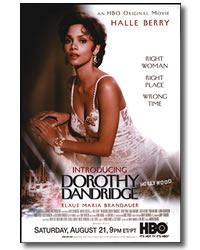
For example, Dorothy Dandridge’s films in the 1950s. Carmen Jones is a film that has been rigorously critiqued for its reproduction of black stereotypes. It’s based on Bizet’s opera but utilizes all these Southern stereotypes. I question whether that’s the extent to which black audiences in the 50s consumed, absorbed, received these images. When I talked to people who watched these films in the 50s from the balconies of white theatres or in colored theatres in the South, they said to me, We were so proud to see beautiful black people on the screen [despite stereotyped roles]. James Baldwin had a critical awareness of [this situation]. In his book The Devil Finds Work, and in other writings like The Price of the Ticket, he said, There’s scarcely an African-American actor who has not been misused, speaking of the films that Dandridge and Poitier [Carmen Jones co-stars] were making in the 50s and 60s. But black audiences and black critics knew that the roles were limited by mainstream white society, but were also pleased to see, as Baldwin said, people sneaking in kernels of truth in the performance.
It appears that Whoopi Goldberg is the first major black actress to acknowledge the stereotypes of black cinema in her roles and explode them. Maybe Pam Grier less so, because she was less empowered due to her era.
I would agree, but Pam Grier’s tough-girl, kick-ass persona from the sexploitation prison films was one that translated very well into the Blaxploitation films. Though it comes out of Roger Corman and AIP [American International Pictures, B-level grindhouse films]. Out of Corman’s stable of tough-girl personas: the role reversals that he loved putting in his films. It worked very well in Blaxploitation. And black audiences enjoyed these films. (But) I do want to clarify something: I don’t want to give you the impression that Blaxploitation was unanimously accepted by a monolithic black audience. Not true.
Grier became a figure of, a repository for, black nationalist sentiment and an icon of black power in the 70s. A tough-talking but sexy black power figure, standing up for the community against whomever the bad guys were—black or white. If they were bringing the black community down, Pam Grier was going to take them out.
How can we become more discerning moviegoers when it comes to cinema that profiles the American black experience?
We can communicate with studios [by supporting] the types of films we want to see. [Jonathan Demme’s 1998 film] Beloved in a perfect example of that. It is a film that African-American audiences should have supported by going when it was in theatres to see it and improving its box office revenue. The analogy is: Don’t you think that supporting films like Beloved is akin to voting? Studios look at what these films make: how many tickets they sold opening weekend, as an indication of what people will go to see. We have to support films, [in order] for people who are making decisions about green-lighting pictures to know that they are bankable.
Divas on Screen: Black Women in American Film, by Mia Mask, should be available in local bookstores. We recommend Inquiring Minds (Saugerties, New Paltz) and Oblong Books and Music (Rhinebeck, Millerton)
Hollywood posters and stills courtesy John Kisch/The Separate Cinema Archive
www.separatecinema.com
[top]
