

sky light on modern art:
Dia Beacon, Riggio Galleriesby Ross Rice
Mid-October, a Saturday at noon: “Beacon Day” at the world-renowned Dia:Beacon Riggio Galleries is turning out to be a success. It's a day when the hometown residents get free admission and a very special treat—a performance by the legendary (and long time Beacon-ite) Pete Seeger. Accompanied by some friends and a gaggle of precocious kids, Pete directs a sing-along of songs that are in every single attendees DNA, and there is a palpable warmth and sense of community that settles over all. as Pete wraps up with a rousing version of “Ghost Riders in the Sky,” one youngster in particular gets the most out of the “yippie-ty-yays.”
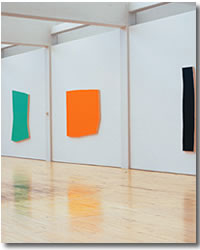
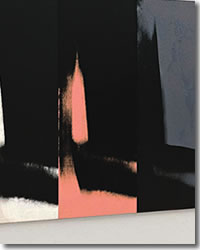
Stepping back as the last notes fade, it becomes apparent that the warmth I’m feeling is also visual, a result of the diffused natural light that bathes the interior of the gallery room. No track lighting. And the room I’m in is actually the size of most galleries, if not much larger. Scanning along the walls, the colorful repetition of Andy Warhol’s multi-canvas Shadows (1978-79) pulls in my attention. As a large-scale work, it would be almost impossible to install in all but very few galleries. Yet here it is.
Peeking around the corner, it becomes apparent that there are many more galleries—representing 25 artists work—within the massive enclosure that is Dia: Beacon. With 240,000 square feet of interior space—lit naturally by 34,000 square feet of sky lighting—the sheer enormity impresses, and rather than making the visitor feel small and insignificant, seems to suggest quite the opposite: that anything is possible, scale is not a issue.
Thanks to the increasing suburbanization of manufacturing post-WWII, and the subsequent availability and affordability of large industrial and loft space in urban areas (particularly New York City), it was only natural that contemporary artists of the 60s and 70s would engage the extra space. While hailed and celebrated by their peers and cognoscenti, many of these artists’ large-scaled works were necessarily site-specific, limiting their ability to make an impact on the general public consciousness.
One particular couple was keen on allowing the new works their due attention, and had the financial wherewithal to help. Oil heiress and art patron Phillipa de Ménil, and art dealer husband Heiner Friedrich wanted to support projects “whose nature or scale would preclude all other funding sources.” In 1974 they established the non-profit Dia Art Foundation, taking their name from the Greek word for “through” (as in “seeing the project through”) and began assembling a comprehensive collection of original works by some of the most influential artists at the time: Joseph Beuys, John Chamberlain, Walter De Maria, Dan Flavin, Donald Judd, Imi Knoebel, Blinky Palermo, Fred Sandback, Cy Twombly, Andy Warhol, and Robert Whitman.
Dia also threw their support behind “uncollectable” long-term sited works like Walter De Maria’s Lightning Field (1977) near Quemado, New Mexico, and his The New York Earth Room (1977) and The Broken Kilometer (1979), both in SoHo, New York City; Joseph Beuy’s 7000 Eichen (1987), with trees and basalt columns along West 22nd St.; and Robert Smithson’s Spiral Jetty (1970), a curlicue reaching into the Great Salt Lake, Utah.
A suitably large New York City space was required to show the moveable collection, and in 1987 a four-story warehouse on West 22nd St. was renovated by Richard Gluckman Architects, and opened as Dia: Chelsea, with focus put on individual artists, sometimes giving each an entire floor, allowing exhibitions up to an entire year to show. Until its closing in 2004—due to the expense of necessary renovation to the space to continue as a gallery—Dia: Chelsea premiered works by Robert Ober, Ann Hamilton, Jenny Holzer, Pierre Huyghe, Robert Irwin, Juan Muñoz, Jorge Pardo, Jessica Stockholder, Diana Thater, Lawrence Weiner, On Kawara, Bridget Riley, and Robert Ryman.
But even Dia: Chelsea wasn’t quite large enough to properly accommodate the potential of the complete collection. Fortunately, an almost perfect location became available: a former Nabisco box-printing facility built in 1929 on the banks of the Hudson River, five minutes walking distance from the Metro North train station in Beacon. Then-owner International Paper donated the factory building to Dia in 1999 and with a generous donation from board members Louise and Leonard Riggio (among others) the renovation was underway. Artist Robert Irwin worked in tandem with the architectural firm OpenOffice to devise a master plan that made the most of the building’s qualities—the abundant natural light and broad spans between support columns—while providing idealized areas for the individual artists in the collection. Opening in May 2003 under Director Michael Govan, Dia: Beacon is one of the largest museums to open in the US since MoMA opened in the late 30s.
“(Dia: Beacon) all happened thanks to a dialogue between artist and architect,” says present Dia Foundation Director Philippe Vergne, who came to the position just over a year ago. Having previously been the director of the Contemporary Art Museum in Marseilles and most recently chief curator at Waller Art Center in Minneapolis, Vergne recognizes the importance of Dia: Beacon to the artistic legacy of that period. “Dia makes contemporary artists part of the historical canon. Many of these artists are still alive, still have more works to create.”
It’s quite the experience, walking through the enormous ex-factory, which now feels like nothing of the sort. Imagine an airport that has no concessions, airplanes, noise, or people in a hurry; all natural light and spacious walkways. Instead of gate bays, you enter different areas attuned to the sensibilities of the individual artists, and experience a full body of works as they would like you to. Even if you think you don’t quite “get” contemporary art, you will find your perspective transformed in ways you probably would not expect.
Rounding the corner from the Warhol exhibit, a wide, bright corridor awaits, featuring the Imi Knoebel installation 24 Farben-für Blinky (24 Colors-for Blinky, 1977). Shortly after the unexpected death of his close friend, German painter Blinky Palermo, Knoebel—who had previously confined his palette to strictly black and white—adopted color for the first time in honor of the deceased. The Dia installation of 24 monochromatic polygons, all of different shape and size, sequenced and arranged by the artist himself with twelve on each side, seem innocuous and amorphous at first. But on further inspection, the colors really speak; the shapes seem oddly organic, like missing pieces to….something.
The corridor passes through to Sol Le Witt’s Drawing Series, fourteen key works from the late 60s through early 70s. Math-class doodlers, Spirographers, and maze-makers will find a kindred spirit in the wall-covering line drawings of Le Witt (1928-2007), whose sprawling works are a result of carefully devised pre-set instructions carried out by teams of assistants; rigorous systems that also capitalize on circumstance: architectural limitations, talents of individual assistants, and differentiations of materials and stylus. While the works are all black line on white wall, one special highlight of the exhibition is the four color version of Drawing Series—Composite, Part I-IV, #1-24, A+B (1969), a first shown at Dia: Beacon.
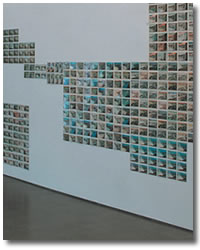
Adjacent to the Le Witt “gallery,” I find myself in yet another long stretch running perpendicular to the Knoebel corridor, lined with patterned sequences of postcards—each depicting the same subject: Niagara Falls. Zoe Leonard’s You see I am here after all (2008) is a new work inspired by the unlimited canvas provided by Dia. Though repetitive and iconic, further attention reveals different photographic styles and technologies in the cards themselves, as well as the documentation of changes to the Falls—which operates as a visual mantra—over time, many due to human intervention.
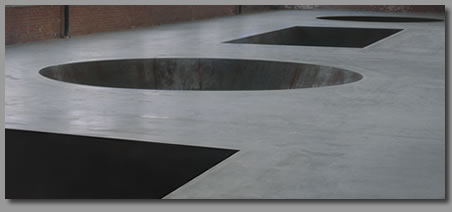
It’s a worthwhile long afternoon taking in the entirety of Dia: Beacon, and frankly, we just don’t have enough magazine here to do it justice. The sepia-toned industrial photography of Bernd and Hilla Becher, Dan Flavin’s oddly comforting minimalist fluorescents, Michael Heizer’s geometric metal “holes,” Richard Serra’s massive sculptures that seem like fragments of some giant technology…well, there’s a whole lot to see here. You shouldn’t visit in a hurry, or on an empty stomach. Should you need repast however, there is a delightful café on the premises, as well as an outstanding little art bookstore.
But it’s not just a gallery here. In 1995, Dia became one of the first arts organizations to encourage using the internet as an artistic medium, commissioning a series of projects connecting artists and audiences via the web long before YouTube. In-house publishing produces books—print and audio—in conjunction with select exhibitions, as well as the permanent collection. Art education programs, the Artist on Artist lecture series, music performances: all are a part of strengthening the cultural life of the community…including today’s “Beacon Day.” And annually, the Merce Cunningham Dance Company has performed special works that provide a visual counterpoint to certain large Dia exhibitions. This November the gallery features the first performances of a year-long residency by the Trisha Brown Dance Company (November 14-15).
And though Director Vergne admits that Dia: Beacon’s emphasis on the artists of the 60s and 70s that comprise the initial collection started by founders de Ménil and Friedrich presents “the danger of (Dia) becoming a time capsule,” Vergne makes the solid point: what better way to inspire the next generation of artists than to celebrate and validate the one immediately preceding? “What is the ‘living’ part of contemporary art today? We need to bring the living artist back.”
Dia: Beacon Riggio Galleries will present two new installations in November, with presentations by Robert Ryman and Agnes Martin, and Gallery Talk: Reiko Tomii on On Kawara on November 28, 1 PM. Performances by the Trisha Brown Dance Company will be November 14-15 at 1 and 3 PM. Please see www.diabeacon.org for gallery times and admission. Dia: Beacon is located at 3 Beekman St., Beacon, 845.440.0100.
[top]
